 The India Energy Hour
The India Energy Hour
The India Energy Hour podcast features in-depth conversations with leading energy, development & climate experts from academia, civil society, & the government. Through these interviews, we explore Indian energy transitions’ most pressing hurdles & promising opportunities. We look at the role that government, financial markets, social movements, & science plays in transition. Co-hosted by Shrey…Social links:
Follow the podcast:
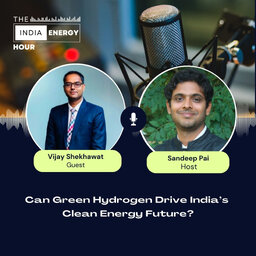
Can Green Hydrogen Drive India’s Clean Energy Future? | ft. Vijay Shekhawat
Hydrogen is gaining significant traction as a key element in the global and Indian transition to clean energy. However, with different types of hydrogen production—green, grey, and blue—there’s much to unpack. Green hydrogen, produced from renewable energy sources, is widely regarded as the most su…
51:16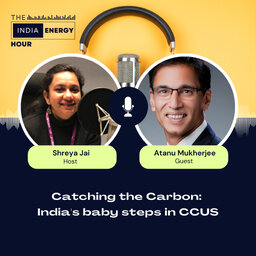
Catching the Carbon: India's baby steps in CCUS | ft. Atanu Mukherjee
As India eyes its net zero targets, Carbon Capture, Utilization, and Storage (CCUS) is becoming central to decarbonizing core industries like steel, cement, and petrochemicals. While the technology holds immense promise, its adoption in India remains limited—hindered by cost concerns and lack of po…
1:05:00
Future-Proofing Indian Businesses: The ESG & Sustainability Imperative | ft. Prarthana Borah
As India transitions toward a low-carbon future, the private sector’s role in embracing sustainability and ESG is paramount. While top corporations lead with ambitious net-zero goals, many small and mid-sized firms are yet to begin their sustainability and ESG journey — held back by data challenges…
1:02:14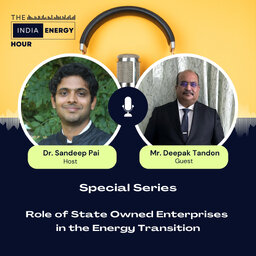
Role of State Owned Enterprises in the Energy Transition | ft. Mr. Deepak Tandon
State-Owned Enterprises (SoEs) in the Oil & Gas sector play a critical role in ensuring energy security for the country. They are among the most diversified entities, spanning the entire oil & gas value chain—from upstream to downstream operations. But as India moves toward its net zero goals, the …
51:17
Role of State Owned Enterprises in the Energy Transition | ft. Dr. B. Veera Reddy
The role of State-Owned Enterprises (SoEs) in India's energy transition cannot be overstated. SoEs, or Public Sector Undertakings (PSUs), control majority of India’s fossil fuel production and provide millions of jobs across the country. As India accelerates its energy transition, these enterprises…
1:04:26
Role of State Owned Enterprises in the Energy Transition | ft. Dr. B. Veera Reddy
The role of State-Owned Enterprises (SoEs) in India's energy transition cannot be overstated. SoEs, or Public Sector Undertakings (PSUs), control majority of India’s fossil fuel production and provide millions of jobs across the country. As India accelerates its energy transition, these enterprises…
1:04:46
जलवायु परिवर्तन का असर आपकी थाली पर | ft. अरविन्द शुक्ला
भारत में सामने आ रहा जलवायु संकट सबसे पहले हमारी प्लेटों को प्रभावित करेगा! खेती की ज़मीन, कृषि उत्पाद, तटीय क्षेत्र जलवायु परिवर्तन से प्रेरित चरम मौसम की स्थिति से सबसे पहले प्रभावित होने वाले क्षेत्रों में से हैं। इससे न केवल भोजन की लागत बढ़ती है, बल्कि कई शोधकर्ताओं का कहना है कि इससे इसका स्…
53:43
Role of State owned Enterprises in the Energy Transition | ft. Mohit Bhargava
India's foray into renewable energy (RE) started with its thermal power giant NTPC Ltd.In the mid-2000s, NTPC, which is also the country's largest power generator, formed a division that would bundle RE with thermal and sell it together. Cut to 20 years later, NTPC has become the first public secto…
1:14:00
Climate Change On Your Plate | ft. Sanjeeb Mukherjee
Climate crisis unfolding in India will first impact our plates! Farms lands, agri commodities, coastal areas are in ten first line of impact from climate change induced extreme weather conditions. Not only does it spike the cost of food, several researchers say it alters its taste and texture too…
57:24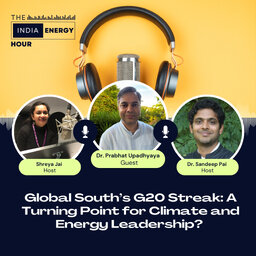
Global South’s G20 Streak: A Turning Point for Climate and Energy Leadership? | ft. Dr. Prabhat Upadhyaya
The consecutive G20 presidencies of Indonesia (2022), India (2023), Brazil (2024), and South Africa (2025) has resulted in four consecutive G20 presidencies held by emerging economies. This moment is hailed by many as a grand opportunity for Global South countries to make a push on different topics…
51:30