 CountryWide CONNECT
CountryWide CONNECT
CountryWide CONNECT is the latest innovative daily livestreamed rural video/radio show broadcast at lunchtime 11am – 1pm Monday-Friday from Christchur…-
Food and Fibre exports forecast to hit record sixty-four billion dollars
-
Government invests in land use options for Māori landowners
-
Forty million dollar investment for rural catchment groups announced at Fieldays
Rural News is in partnership with Farmlands as part of CountryWide CONNECT with Andy Thompson & Sarah Perriam-Lampp - our daily rural show livestreamed from 11am-1pm. Visit country-wide.co.nz on how to watch / listen.
Food and Fibre exports forecast to hit record sixty-four billion dollars
New Zealand's farmers and growers are delivering record results, with food and fibre exports forecast to reach sixty-four-point-three billion dollars in the year to June — up six percent and a new high across multiple sectors.
Dairy leads the way, up five percent to a record twenty-eight-point-six billion dollars, while meat and wool has surged fourteen percent to a record fourteen-point-one billion.
Horticulture is up seven percent to nine-point-five billion, driven by bumper kiwifruit and apple crops.
The figures, released in MPI's Situation and Outlook for Primary Industries report launched at Fieldays today, reflect high milk prices, record milk production and tight global red meat supply — with strong farmgate returns expected to cushion the impact of Middle East shipping disruptions.
Exports are forecast to grow to seventy-point-one billion dollars by 2030.
Government invests in land use options for Māori landowners
Māori landowners could unlock productivity gains of ten to thirty percent under a new government-backed project aimed at giving them better tools to understand and optimise their farming systems.
The Government is investing up to two-point-six million dollars over two years, working in partnership with Te Arawa Primary Sector Incorporated to help Māori landowners identify options that grow production value while maintaining or improving environmental performance. Early modelling also shows potential greenhouse gas emission reductions of five to twenty-five percent.
Māori Development Minister Tama Potaka says the project is about generating more value from land, growing businesses and helping protect whenua for future generations — giving Māori landowners the confidence to innovate and build prosperity through productivity.
Data from the project will be shared more broadly across the farming sector.
Forty million dollar investment for rural catchment groups announced at Fieldays
Rural catchment groups will receive greater funding certainty under a forty-point-five million dollar government investment over the next four years, supporting fifty-one groups and collectives operating across New Zealand.
Associate Agriculture Minister Mike Butterick says every group currently receiving MPI funding will continue to be supported, with thirteen-point-five million dollars allocated in the coming year — including groups previously funded through the Ministry for the Environment and the New Zealand Landcare Trust.
Butterick says rural catchment groups have been a genuine success story, delivering environmental gains on the ground across the country. He says farmers' involvement is testament to how deeply they care about the land they work on.
This year, seventeen regional catchment collectives will be funded to improve coordination and wider coverage.
MPI has been asked to develop a plan for longer-term funding arrangements for the sector.
In 1 playlist(s)

CountryWide CONNECT
CountryWide CONNECT is an innovative daily livestreamed rural video/radio show broadcast at lunchtim…Social links
Follow podcast
Recent clips

Will Burrett - Pāmu building relationships between dairy and beef
13:21

Luke Fisher - Reinventing Farmlands to better support farmers
09:45
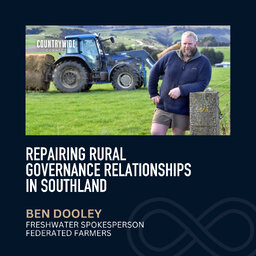
Ben Dooley - Repairing rural governance relationships in Southland
12:12