 The Adelaide Show
When Indian cricket fans unleash fury on Twitter about disputed LBW calls, host Steve Davis fields the abuse meant for someone else. This episode brings together both Steve Davises for the first time. The retired umpire who stood in 57 Test matches shares what it’s like to make split-second decisions in front of millions, survive a terrorist attack in Lahore, and maintain composure when Shane Warne announces his next delivery to the batter.
The SA Drink of the Week features Ballycroft Vineyard and Cellars’ 2024 Small Berry Montepulciano from Langhorne Creek, tasted and endorsed by both Steve Davises. The wine presents an intriguing contradiction, its dark appearance suggesting heavy Barossa Shiraz, yet delivering a lighter, fruit-forward palette that Joe Evans recommends chilling for summer enjoyment.
The Musical Pilgrimage features Steve Davis and the Virtualosos with “From the Cathedral to the City End,” weaving together Test cricket, Adelaide Oval, and the 1662 Book of Common Prayer into a meditation on how this game brings us together.
You can navigate episodes using chapter markers in your podcast app. Not a fan of one segment? You can click next to jump to the next chapter in the show. We’re here to serve!
The Adelaide Show Podcast: Awarded Silver for Best Interview Podcast in Australia at the 2021 Australian Podcast Awards and named as Finalist for Best News and Current Affairs Podcast in the 2018 Australian Podcast Awards.
And please consider becoming part of our podcast by joining our Inner Circle. It’s an email list. Join it and you might get an email on a Sunday or Monday seeking question ideas, guest ideas and requests for other bits of feedback about YOUR podcast, The Adelaide Show. Email us directly and we’ll add you to the list: podcast@theadelaideshow.com.au
If you enjoy the show, please leave us a 5-star review in iTunes or other podcast sites, or buy some great merch from our Red Bubble store – The Adelaide Show Shop. We’d greatly appreciate it.
And please talk about us and share our episodes on social media, it really helps build our community. Oh, and here’s our index of all episode in one concise
page.
Running Sheet: Steve Davis Talks Cricket With Former Umpire Steve Davis
00:00:00 Intro
Introduction
00:01:50 SA Drink Of The Week
The SA Drink Of The Week this week is a 2024 Ballycroft Montepelciano.
Joe Evans of Ballycroft Vineyard and Cellars made an unexpected connection five weeks before this recording. During a Barossa wine tour for friends visiting from England, Steve Davis the umpire introduced himself at the cellar door. Joe mentioned knowing another Steve Davis from Adelaide, someone involved in cricket. The dots joined. Both Steve Davises then converged on this episode, linked by Langhorne Creek grapes and the patron saint of Adelaide.
The 2024 Small Berry Montepulciano arrives in the glass looking deceptively heavy. Its dark colour suggests bold Barossa Shiraz, thick and commanding. Yet the first sip tells a different story. Light fruit dances on the palette, a brightness unexpected from that brooding appearance. Joe recommends chilling it slightly and serving through summer, perfect with Italian or Mexican food.
Steve the umpire remembers that 10:30am Sunday morning tasting at Ballycroft. When Joe poured this wine, Steve thought immediately of Barossa Shiraz. That’s his drink. But then came the taste, revealing something gentler yet structured. The wine builds as it sits on the palette, gaining weight and presence. Like a pitch heading into day three or four, settling into its rhythm rather than losing life.
The conversation meanders through wine, travel and cuisine. West Indies food has never won Steve’s heart, so more of this Montepulciano would help those meals considerably. Host Steve notes how the wine shifts from what seems like a marriage between Pinot Noir and rosé to something with genuine body and staying power. It’s not Pinot weight, not Grenache or Merlot either. The complexity reveals itself slowly, rewarding patience.
The 2024 Small Berry Montepulciano from Ballycroft Vineyard and Cellars, endorsed by two Steve Davises, stands as this week’s South Australian drink.
00:10:25 Steve Davis and Steve Davis
INTRODUCTION:
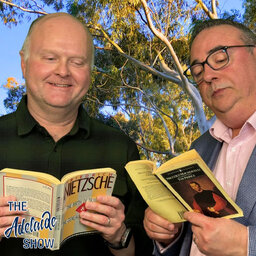
So, I need to come clean about something. For years on Twitter, I’ve been fielding abuse meant for someone else. Indian cricket fans would see “Steve Davis” and unleash fury about a disputed LBW or a missed edge – and when I’d reply, mortified apologies would flood in. They’d meant the *other* Steve Davis. The one who stood in 57 Test matches, 137 ODIs, survived a terrorist attack in Lahore, and spent 25 years making split-second decisions in front of millions. Today, finally, I get to meet the bloke whose honour I’ve been accidentally defending. Steve Davis, welcome to The Adelaide Show.
NOTES:
The conversation begins with a revelation. Far from being retired, Steve Davis the umpire spends twelve months a year refereeing cricket across two continents. Every six months he travels to England for County Cricket, returning to Australia for Sheffield Shield and Big Bash matches. When he thought retirement from umpiring might leave him lost, the England and Wales Cricket Board offered him a lifeline that turned into a globe-trotting vocation.
His cricket origins trace back to Elizabeth, newly formed with perhaps eight houses when his parents arrived as ten-pound Poms. His father Dave Davis played for WRE Cricket Club alongside John Scarce, whose son Kevin Scarce kept wicket for Steve at Elizabeth High School and later became Governor of South Australia. Cricket in Adelaide was woven through family, friendship and those Saturday afternoons where you’d stand in as a sub fielder, watching your father’s team and falling deeper into the game’s rhythm.
The path to international umpiring began humbly in D Grade after finishing his playing career at West Torrens. Within two seasons he’d progressed to A Grade, and by November 1990 he was officiating his first Sheffield Shield match. His debut came partly through circumstance rather than genius. When Tony Crafter retired to become Australia’s first full-time umpire manager, a vacancy opened among South Australia’s two eligible international umpires. Steve joined Darryl Harper in that select group.
On 12 December 1992, exactly 33 years ago yesterday, he walked onto Adelaide Oval for his first One Day International. Pakistan versus West Indies. His home ground, but the nerves were overwhelming. Terry Prue, his Western Australian colleague, radioed from square leg to report that Richie Richardson had noticed Steve missing all of Wasim Akram’s no balls. In his nervousness, he’d forgotten to look down at the front foot. When he finally started calling them, Wasim’s response was gentlemanly: “Oh, come on, we’re all friends out here. Give me a bit of warning.”
The umpire’s process demands intense concentration. First, watch the front foot land. The moment it’s safe, eyes shoot straight to the bottom of the stumps, letting the ball come into view. As soon as the ball dies, switch off briefly, then begin again. Steve ran his counter one ball ahead, clicking after each delivery so the number five meant two balls remaining. This meant no clicking back for no balls, just not clicking forward. Tim May once stopped mid-delivery and demanded Steve stop clicking his counter during the run-up.
His Ashes Test debut at Adelaide Oval in 1997, just his second Test match, stands as one of his finest days. He got every decision right on a 44-degree day when England lost the toss and their bowlers were bowling one-over spells in the heat. Steve Bucknor, his partner that day, also had a flawless match. Alex Stewart still calls him “legend” when they meet at English grounds.
The Decision Review System arrived while Steve was umpiring, transforming the role completely. Some umpires, like Mark Benson, couldn’t handle seeing their decisions overturned repeatedly. Benson flew home after two days of a Test match in Australia and never returned to international cricket. Steve embraced DRS immediately. His philosophy was simple: we’re going to end up with the right decision. Better that than five days of a team reminding you about that first-ball error while the batter you gave not out compiles a century.
These days, third umpires call all no balls in televised matches. The technology highlights the foot crossing the line, removing that split-second judgment from the on-field umpire. Steve wonders if he’d survive in today’s game, his neural networks so hardwired to glance down then up that retraining might prove impossible.
The theatre of the raised finger remains cricket’s most iconic gesture. Steve took his time with it, though not as long as his late friend Rudy Koertzen, dubbed “Slow Death” for the excruciating journey his hand took from behind his back to above his head. Some umpires point at the batter instead of raising the finger, a practice Steve abhors. The law says raise the index finger above your head. The drama lies in that pause, that moment of tension before the finger rises.
He carried the essentials: a counter, a wallet-style kit with sprig tightener, pen and pencil, notepad for recording incidents, light meter readings, and lip balm. Some umpires packed their pockets with everything imaginable, but Steve kept it minimal. His process worked. He knew what every ball demanded of him.
Shane Warne’s deliveries would fizz through the air with such spin and accuracy that he’d announce his intentions to batters. “This is my wrong one. This one’s going on your leg stump.” It worked brilliantly, planting doubt even as batters wondered if he really meant it. Murali presented different challenges. Steve couldn’t predict where his deliveries would spin until he noticed Sangakkara’s gloves lining up behind the stumps. The great wicketkeeper knew exactly where every Murali ball was heading, providing Steve a crucial visual cue.
The conversation turns to safety. Fast bowlers send the ball down at 150 kilometres per hour. When batters connect with the full force of their bats, that ball can come back even faster. Steve got hit more than once. At St Lucia during a West Indies versus Pakistan match, he turned at the wrong moment and the ball struck him square in the backside. Looking up at the big screen, he saw himself mouthing the words that immediately came out, while David Boon and Paul Reiffel, his Australian colleagues that day, doubled over in laughter. The Pakistani batter complained that Steve cost him four runs. Steve’s reply: “Bad luck. You cost me a bruised bum.”
The smashing of glass still triggers something in him. Loud noises. Fireworks. His wife Annie says he didn’t get enough counselling after Lahore. She’s probably right. On 3 March 2009, terrorists attacked the Sri Lankan team’s convoy in Lahore. Steve’s van, carrying the umpires, was the only vehicle left in the roundabout after the team’s bus escaped. Every window was shot out. The driver died instantly from a gunshot wound. All five security outriders were killed. Lying on the floor among broken glass, Steve thought: this is not the way I should die. Not here. Not on the way to umpire a Test match.
They survived. The terrorists realised the Sri Lankan team had escaped and stopped firing. Steve returned to umpiring but never went back to Pakistan. He did return to other parts of the subcontinent, to other places that required trusting local security. During the drive back to the hotel after the attack, past kids playing cricket on dust bowls, he knew Pakistan wouldn’t see international cricket for years. Those kids who loved the game wouldn’t see their heroes. The political and ideological conflicts would keep cricket away.
Asked which game he’d relive for eternity, Steve chooses that second Test match at Adelaide Oval. The Ashes. England versus Australia. His home ground. Forty-four degrees. Every decision correct. Recognition from players like Alex Stewart who still speak warmly of his performance. It represents everything he worked towards: getting it right when it mattered most, on the ground where he grew up watching cricket, in the series that defines the sport.
He umpired with characters who became dear friends. Ian Gould, whose father was also named Cyril George, just like Steve’s dad. An impossibly unlikely pairing of names that bonded them immediately. In Calcutta, when Gould was being carted off to hospital with dehydration, he had to fill out a form listing his father’s name while smoking and drinking black tea. Steve looked over his shoulder and saw “Cyril George” written there. On Gould’s final stint umpiring in Birmingham, Steve was the referee. They spent every evening walking the canals with a few pints, the only four-day match where Steve never filed a meal claim. Rudy Koertzen. Steve Bucknor. These were the colleagues who made the profession worthwhile.
The spirit of cricket exists, though interpretation varies. Steve recalls Andrew Strauss making a fair point during the Steve Finn incident at Leeds. Finn had a habit of knocking the bails off at the bowler’s end with his knee during his delivery stride. Both batsmen, Graeme Smith and Alvaro Petersen, complained it was distracting. When Finn did it again and Smith edged to Strauss for a catch, Steve had already signalled dead ball. Strauss came over and said quietly: “Why didn’t you tell me you were going to do that?” Steve acknowledged it was a fair point. He probably should have warned the captain. The laws changed after that Test. If stumps are dislodged at the bowler’s end, it’s now a no ball. Cricket people sometimes call it the Steve Finn Steve Davis law change.
Cricket’s hierarchy remains clear. Test cricket stands at the pinnacle. Always has, always will. Ask any umpire who the best officials are, and they’ll list those who’ve done the most Tests. Steve’s 57 Tests mean everything to him. The 137 ODIs are nice, but Tests define an umpiring career. The Hundred in England draws families beautifully, but Test cricket is where greatness lives.
At the end of play, Steve would call “Time, gentlemen. That’s time.” A simple phrase marking the end of another day’s combat, another day of split-second decisions, theatre, and that noble spirit that still runs through cricket despite everything that tries to corrupt it.
02:00:15 Musical Pilgrimage
In the Musical Pilgrimage, we listen to From The Cathedral To The City End by Steve Davis & The Virtualosos.
IThe Cathedral looms over Adelaide Oval, watching cricket unfold from the city of churches. Steve Davis and the Virtualosos have woven together Test cricket, the Cathedral End, and the 1662 Book of Common Prayer into “From the Cathedral to the City End.” The song opens with the Prayer of Humble Access rewritten: “We do not presume to come to this thy over trusting in our own righteousness.”
Host Steve explains his childhood love for that beautiful English language, attending Church of England services where those words embedded themselves in his memory. The prayer’s cadence and dignity stayed with him. When writing this song, he wanted to capture three elements: Test cricket, Adelaide Oval’s special significance through Bradman and Bodyline, and that cathedral presence overlooking the ground.
The question arises: have you ever stood as an umpire and thought a captain made a terrible decision bringing on a particular bowler at the wrong end? Steve the umpire smiles. Sure, sometimes you think it’s surprising, maybe even adventurous under your breath. But someone who knows better than you made that choice, usually the bowler themselves selecting their preferred end. Most decisions are sound, even if they don’t prove successful. You can’t roll your eyes. You can’t show any reaction.
Commentators now need special accreditation to enter certain areas. The hierarchy maintains that barrier. Umpires can visit the press box, but commentators can’t come into the umpires’ area without risking trouble. It’s a good separation. Before play they chat on the field, saying hello to the numerous commentators modern broadcasts require. Steve never worried about Tony Greig sticking his key into the pitch. Didn’t seem to do much damage.
The song plays, capturing that ritual: hours before proceedings commence, sandwiches thoughtfully made, pushing close to the fence, ladies and gentlemen on the village green putting down their glasses. Two thousand balls, two thousand trials, each one potentially a wicket or hit for miles. Concentration demanded because no two are the same. From the Cathedral to the City End, making cricket bring us together again, forever and ever and ever.
In 1 playlist(s)

The Adelaide Show
A podcast recorded in Adelaide that puts South Australian passion on centre stage with a featured gu…Social links
Follow podcast
Recent clips

436 - Rag-Tag Extremists
2:11:42

435 - The Adelaide Show Spin Detector
42:27
434 - Something Has Broken: SA Politics, the Park Lands, and the Politics of Distraction
55:52