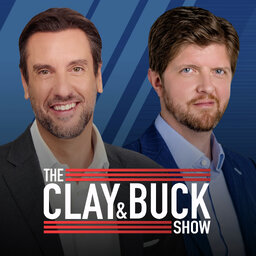
The Clay Travis and Buck Sexton Show
Hour 3 of the Clay Travis and Buck Show focused on government infrastructure, aviation safety, transportation modernization, crime and public safety, housing affordability, workforce development, skilled trades, politics, energy prices, and the evolving political landscape ahead of the 2028 election cycle. The hour opened with an extensive discussion of the recent FAA system outage and broader concerns about America’s aging infrastructure. Clay and Buck analyzed comments from Transportation Secretary Sean Duffy, who stated that investigators had found no evidence of a cyberattack and instead blamed the disruption on outdated network and telecommunications systems. The hosts examined the vulnerability of decades-old FAA technology, ongoing efforts to replace copper-based infrastructure with fiber networks, and the need for a comprehensive modernization of the nation’s air traffic control system. They argued that maintaining safe and reliable aviation infrastructure should be among the highest national priorities and questioned why critical upgrades often take years to complete despite significant federal spending.
The conversation expanded into a broader examination of American infrastructure, government efficiency, and public works projects. Clay and Buck compared today’s large-scale government projects to historic achievements such as the Interstate Highway System, the Hoover Dam, and the Empire State Building. They questioned whether modern government institutions remain capable of completing major infrastructure initiatives efficiently and cited examples such as California’s high-speed rail project, the Boston Big Dig, bridge reconstruction efforts, and transportation projects in Miami. The hosts contrasted government delays and cost overruns with private-sector accomplishments, particularly SpaceX’s reusable rocket program, arguing that innovation and execution increasingly occur outside government rather than within it.
A significant portion of Hour 3 centered on criminal justice, crime policy, Washington, D.C. public safety, and sentencing practices. Clay highlighted a case involving a 19-year-old suspect who fired approximately 20 rounds in Northwest Washington, D.C., striking a bystander playing basketball. The hosts criticized the sentencing outcome, noting that the individual reportedly received probation rather than prison time after pleading guilty to multiple offenses. They argued that policies aimed at rehabilitation for younger offenders can sometimes conflict with public safety concerns and used the case to discuss broader debates over prosecutorial discretion, violent crime, repeat offenders, and criminal justice reform in major cities.
The discussion also touched on gun laws, enforcement disparities, and high-profile legal cases. Buck contrasted the sentencing decision in the Washington, D.C., shooting case with previous prosecutions for technical firearm-related offenses, arguing that serious violent crimes are sometimes punished less aggressively than regulatory violations. The hosts used those comparisons to criticize what they described as inconsistent approaches to law enforcement and prosecution, particularly in large Democratic-led cities. The conversation expanded into a broader critique of urban crime policy, sentencing standards, and public perceptions of fairness within the justice system.
Housing affordability returned as a major topic throughout the hour. Following discussions from Hour 2, Clay and Buck continued exploring why homeownership remains increasingly difficult for younger Americans. Listener calls contributed to the conversation, particularly from individuals involved in construction, homebuilding, and education. One caller argued that a shortage of skilled trades workers has become a significant factor driving housing costs higher, explaining that contractors often face overwhelming demand and limited labor availability. The hosts agreed that vocational careers and trade professions represent an increasingly attractive alternative to expensive four-year college degrees and discussed how shortages in skilled labor affect construction timelines, housing inventory, and overall affordability.
Workforce development, vocational education, and American manufacturing also featured prominently. Clay and Buck discussed the growing demand for electricians, builders, contractors, and construction professionals while criticizing educational systems that have historically emphasized college attendance over skilled trades. They highlighted large-scale data center construction projects as examples of industries creating well-paying jobs while supporting America’s technological competitiveness. The hosts argued that investment in domestic infrastructure, energy production, semiconductor manufacturing, and data centers is critical to long-term economic growth, national security, and maintaining technological independence from foreign competitors.
The hosts also mixed in lighter moments throughout the hour, including a brief appearance by a young child in the studio that generated discussion about the popularity of family-oriented and positive content on social media. Clay and Buck joked about audience reactions, discussed listener feedback, and revisited previous debates over housing prices, generational differences, and quality-of-life concerns. These conversations served as a contrast to the more serious discussions surrounding infrastructure and public policy.
Politics and the 2028 election cycle became a major theme during the final segment of the hour. Clay and Buck discussed Representative Alexandria Ocasio-Cortez (AOC), her media appearances, and her growing prominence within national Democratic politics. While disagreeing with many of her policy positions, the hosts argued that her communication skills, personal charisma, and media effectiveness make her a potentially formidable political figure. They speculated about future Senate and presidential ambitions and examined how individual likability can influence political success even in highly polarized environments.
The hour also included discussion of energy markets, inflation, consumer costs, and economic trends. Clay pointed to falling gasoline prices, noting that national average fuel costs had declined significantly, while also discussing increased global oil and gas supply. The hosts argued that energy production remains a key economic issue affecting inflation, household budgets, transportation costs, and broader economic confidence. They connected lower fuel prices to wider discussions about affordability and consumer sentiment.
In the closing minutes, the conversation shifted briefly to sports, college football, and the NFL. Clay provided Buck with a rapid overview of the current football landscape, discussing college football playoff expansion, identifying Georgia as the leading college football program, and naming the Buffalo Bills and San Francisco 49ers as the most impressive NFL teams midway through the season. The segment concluded with lighthearted banter about using these talking points to sound informed at social gatherings and dinner parties.
Make sure you never miss a second of the show by subscribing to the Clay Travis & Buck Sexton show podcast wherever you get your podcasts! ihr.fm/3InlkL8
For the latest updates from Clay & Buck, visit our website https://www.clayandbuck.com/
Connect with Clay Travis and Buck Sexton:
FB - https://www.facebook.com/ClayandBuck/
IG - https://www.instagram.com/clayandbuck/
YouTube - https://www.youtube.com/c/clayandbuck
Rumble - https://rumble.com/c/ClayandBuck
TikTok - https://www.tiktok.com/@clayandbuck