 The Clay Travis and Buck Sexton Show
Hour 3 of The Clay Travis and Buck Sexton Show wraps up the Friday program with a wide-ranging discussion of President Donald Trump, gas and diesel prices, the Russia-Ukraine war, state and local taxes, cost of living, migration from high-tax states, artificial intelligence, China, data centers, Florida politics, the 2026 midterm elections and college football. Clay Travis and Buck Sexton open the third hour by discussing President Trump’s comments on energy costs and the effect of the ongoing Russia-Ukraine war on diesel prices. They lament the enormous casualties and continued destruction from the conflict and the lack of a diplomatic breakthrough. The hosts also note Vice President JD Vance’s focus on financially strained American communities as Republicans seek to return attention to domestic affordability and economic issues ahead of the midterm elections.
A major portion of Hour 3 examines state income taxes, cost of living and the financial differences between red states and blue states. Using NFL quarterbacks as high-profile examples, Clay cites comparisons involving Lamar Jackson, Brock Purdy and Dak Prescott to illustrate how dramatically state and local tax burdens can vary depending on where someone lives and works. The hosts contrast high-tax jurisdictions such as California, New York, Illinois and Maryland with states including Florida, Tennessee and Texas, which have no individual state income tax. They debate whether multimillion-dollar tax differences significantly affect the lifestyles of athletes earning roughly $50 million annually, with Buck arguing that the impact may actually be more meaningful for upper-middle-income professionals and small-business owners earning between roughly $150,000 and $500,000 a year. Clay counters that even very wealthy taxpayers can eventually become unwilling to surrender millions of dollars annually when they have the ability to relocate.
Clay and Buck broaden the tax discussion into the post-COVID migration from New York, California and other high-cost states to Florida, Tennessee and Texas. They argue that remote work demonstrated to executives, entrepreneurs and other highly mobile earners that living in New York City, Los Angeles or Chicago is no longer essential for many careers. Clay predicts that high earners will increasingly move toward lower-tax states, potentially putting additional pressure on the tax bases and government budgets of high-tax jurisdictions. Buck emphasizes that taxes are only one component of the equation, noting that housing, gasoline and other everyday expenses also vary substantially by state. The hosts discuss whether residents receive sufficient value for high taxes, specifically criticizing New York City public schools and pointing to the additional financial burden faced by families who pay high taxes but still choose private, religious or parochial schools. Family ties and jobs, they agree, remain two of the strongest reasons people stay in expensive states even when they are dissatisfied with taxes or government services.
The centerpiece interview in Hour 3 of Clay and Buck is with Rep. Kat Cammack of Florida, who joins the show to discuss artificial intelligence, AI regulation, China, Congress and data centers. Cammack argues that fears of an imminent AI apocalypse resemble Hollywood science fiction more than a serious assessment of emerging technology. She criticizes members of Congress whom she believes lack even a basic understanding of artificial intelligence while nevertheless seeking to regulate it. Clay compares the current AI moment with the early development of the internet, arguing that government restraint allowed that technology to evolve before lawmakers attempted to impose extensive rules. The conversation also references Elon Musk’s optimistic assessment of AI’s potential impact on U.S. economic growth and explores whether premature federal regulation could suppress innovation, investment and American competitiveness.
Cammack argues that Congress should avoid knee-jerk responses to political pressure and instead develop a deeper technical understanding of AI policy and regulation. She says regulatory consistency is essential if companies are expected to make enormous long-term capital investments and discusses the REINS Act as part of a broader effort to restrain federal regulation. The larger debate centers on the trade-off between legitimate rules that establish a competitive playing field and excessive government intervention that could undermine one of the most important technologies shaping the American economy and national security.
The interview then turns specifically to AI data centers, electricity rates, water use and local zoning. Clay and Buck raise the growing public backlash to data-center development and discuss Florida policies designed to prevent large data centers from shifting their electricity costs onto ordinary ratepayers, encourage the use of reclaimed water and allow communities to exercise zoning authority. Cammack supports those principles and emphasizes local control, arguing that communities should be able to welcome data centers or prohibit them according to local preferences. She also discusses federal efforts aimed at making large developments responsible for their own energy costs rather than transferring those expenses to consumers.
Cammack adds a national-security dimension to the data-center debate by arguing that some online opposition to American AI infrastructure is being amplified by China and the Chinese Communist Party. She warns about what she describes as Chinese information operations and cognitive warfare designed to influence Americans on technology policy. Cammack also stresses that data centers do not exist exclusively for generative AI, explaining that cloud computing encompasses services ranging from email to video streaming. Her overarching argument is that the United States must balance local concerns surrounding electricity, water and zoning with the strategic imperative of maintaining technological leadership over China.
Hour 3 then moves into Florida politics and the 2026 midterm elections. Asked about Florida’s newly redrawn congressional map, potential Republican gains, the Senate race, the governor’s race and voter enthusiasm, Cammack offers a cautious assessment rather than predicting an easy Republican victory. She says Republicans have accomplished important goals, including lower taxes and investment in rural health care, but argues that they have not done enough to advance the America First agenda or reverse the long-term growth of government. She identifies high diesel and gasoline prices, housing affordability, interest rates, grocery bills and prescription drug costs as major voter concerns and warns that frustrated voters could simply stay home. Cammack says Republicans need to acknowledge economic pain directly and make the case for what they intend to accomplish next. The political conversation closes on a lighter note with discussion of her Florida Gators and their matchup against Auburn.
In the final stretch of Hour 3 of The Clay Travis and Buck Sexton Show, Clay previews a separate conversation with former college basketball coach Bruce Pearl, including Pearl’s reflections on career decisions, coaching and the emotional difficulty of leaving a team. That leads into a broader sports discussion about Florida Gators football, Auburn, the Miami Hurricanes, Tennessee football and the college football weekend. Clay and Buck debate Florida’s prospects, joke about the increasingly advanced ages of some college quarterbacks and preview their weekend plans, with Clay preparing for a full slate of college and NFL football as well as his son’s high-school homecoming football game, while Buck plans to continue watching Young Washington
Make sure you never miss a second of the show by subscribing to the Clay Travis & Buck Sexton show podcast wherever you get your podcasts! ihr.fm/3InlkL8
For the latest updates from Clay & Buck, visit our website https://www.clayandbuck.com/
Connect with Clay Travis and Buck Sexton:
FB - https://www.facebook.com/ClayandBuck/
IG - https://www.instagram.com/clayandbuck/
YouTube - https://www.youtube.com/c/clayandbuck
Rumble - https://rumble.com/c/ClayandBuck
TikTok - https://www.tiktok.com/@clayandbuck
In 1 playlist(s)
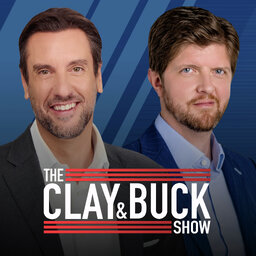
The Clay Travis and Buck Sexton Show
The Clay Travis and Buck Sexton Show. Clay Travis and Buck Sexton tackle the biggest stories in news…Social links
Follow podcast
Recent clips
Weekly Review With Clay and Buck H1 - El-Sayed Will Run for President
36:46
Weekly Review With Clay and Buck H2 - Voters Don't Care About Iran
36:43
Weekly Review With Clay and Buck H3 - Sophie Haters Are Just Jealous
36:45