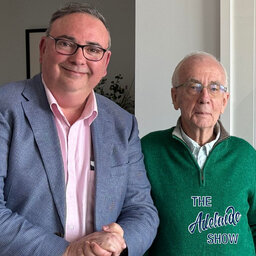
433 - History Hit ParadeThere are episodes of The Adelaide Show, and then there are events. This is one of the latter. Recorded live at the Mercury Cinema as part of South Australia’s History Festival 2026, History Hit Parade brings together broadcaster and journalist Keith Conlon and host Steve Davis for a ninety-minute show that weaves original songwriting with storytelling, historical context, and the kind of warm, unhurried conversation that feels like sitting in a room full of people who actually know where you live. Ten songs. Ten slices of South Australian life. All of them written with pen and paper by Steve, given musical life through his AI-assisted “virtual session band,” and offered here as what he describes as “audition pieces” for real musicians who might one day make them their own.
There is no SA Drink of the Week in this episode.
The entire show is the Musical Pilgrimage. Rather than a single track appended at the end, this episode is the songs, each one set up by Keith’s historical grounding and Steve’s personal connections before the music rolls. Full notes on each song appear in the segment breakdown below.
You can navigate episodes using chapter markers in your podcast app. Not a fan of one segment? You can click next to jump to the next chapter in the show. We’re here to serve!
The Adelaide Show Podcast: Awarded Silver for Best Interview Podcast in Australia at the 2021 Australian Podcast Awards and named as Finalist for Best News and Current Affairs Podcast in the 2018 Australian Podcast Awards.
And please consider becoming part of our podcast by joining our Inner Circle. It’s an email list. Join it and you might get an email on a Sunday or Monday seeking question ideas, guest ideas and requests for other bits of feedback about YOUR podcast, The Adelaide Show. Email us directly and we’ll add you to the list: podcast@theadelaideshow.com.au
If you enjoy the show, please leave us a 5-star review in iTunes or other podcast sites, or buy some great merch from our Red Bubble store – The Adelaide Show Shop. We’d greatly appreciate it.
And please talk about us and share our episodes on social media, it really helps build our community. Oh, and here’s our index of all episode in one concise
page.
Running Sheet: History Hit Parade
00:00:00 Intro
Introduction
00:00:00 SA Drink Of The Week
There is no SA Drink Of The Week this week.
00:04:07 History Hit Parade
The Mercury Cinema is not a neutral venue for Steve Davis. He was married there on a sweltering 42-degree December day in 2002. He launched Talked About Marketing there. And it is where, on two days in May 2026, he and Keith Conlon performed History Hit Parade to an audience that included Steve’s parents, his former drama teacher, the chair of the History Trust, and the real-life couple immortalised in one of the songs.
The name History Hit Parade, Steve reveals, was Keith’s idea, drawn from his memory of the Harold Wright Hit Parade on 5AD, a Thursday-night ritual of about eight or ten songs in an era before the Top 40 existed. Buddy Holly, Elvis, Perry Como, and Pat Boone: that was your week’s music. The name lands perfectly for a show that does something similar, except every track is an original, and every track is South Australian.
Song 1: Jack and Lil (Up Please, Going Up)
Keith sets the historical scene: John Martins began as Peters and Martin, a drapery store in Rundle Street, until Mr Martin was released from his duties due to what Keith delicately describes as “debauchery.” The Hayward family eventually took the helm, and it was Sir Edward Hayward who, in 1933, looked to Canada for inspiration and brought the Christmas Pageant to Adelaide. He was so nervous before the first one that he hired a biplane, circled the inner suburbs with a megaphone, and personally invited people to come. They did. About 300,000 still do, each year.
The personal thread in this song belongs to Steve’s maternal grandparents, Jack and Lil, whose photograph appeared on the screen behind him. Lil worked in the kitchenware department. Jack was the young engineer installing the new lifts in the building during the 1930s. The rest, as Steve says, is history. The song follows their life together as their family grows, moving floor by floor through what John Martins offered, with the lift ladies’ announcement, “Up please, going up,” as its guiding refrain. Steve thanks Paul Flavell, who has written a book on John Martins, and former John Martin’s planner, Robert Tedstone, who provided a complete floor-by-floor inventory to keep the lyrics accurate.
Song 2: Oh Marion
Marion, the suburb, was surveyed in 1838 by Colonel Light’s private firm after Light had broken with Governor Hindmarsh. The name comes from Marianne, daughter of resident commissioner James Hurtle Fisher, though somewhere along the way Mariannen became Marion. Keith’s own connection is fond: his father learned to drive in the 1950s by heading south into the almond groves and vineyards of Marion, where the long straight roads offered room to practise.
Steve’s Marion is the 1970s version: aerial photographs, numbered landmarks, railway tracks where he’d flatten 20-cent pieces, overpass pile drivers thumping for weeks, and a Coles New World at the Park Holme Shopping Centre. He walked to school at age six, “with my little satchel and my shorts.” One afternoon he left school early, got lost, and found his way to a doctor’s surgery he recognised. They rang his mother. She wasn’t home. The neighbour came to collect him and made him a sandwich. “That was life in Marion back then,” he says, with a fondness that carries no nostalgia for the vineyards his own family’s house helped displace.
Song 3: My Jolly Valentine
This one starts with the Torrens. Keith explains that before the lake arrived, the river in summer was “a series of rather smelly waterholes” until Mayor Sir Edwin Smith, a beer baron with civic ambitions, created the weir. Within a year of the lake’s arrival in 1882, a rowing craze had taken hold, boat sheds lined the banks, and Jolley’s Boathouse was selling milkshakes and pies to rowers who could rent a boat by the hour.
The Palais de Danse gets its moment: a floating ballroom on a barge moored near the Elder Park Rotunda from 1924, with a soda fountain, no grog, and 800 people on opening night. It was gone by 1928, Keith noting, “maybe it was just not well made and sank slowly into the mud.”
Steve’s research for this Valentine’s Day song turned up two details that captured his imagination. First, the Rundle Street Parade: on Saturday nights, young men would walk down one side of the street, young women down the other, window-shopping for company rather than goods. Second, the postage stamp code used in the twice-daily mail service to communicate what couldn’t be written openly: upside-down meant “I love you,” tilted right meant yes, left meant no, sideways meant “let’s stay as friends,” which Steve notes is “a soft no.”
Song 4: Spring Gully Road
Keith traces the geography first: up Third Creek from the Torrens, past the village of Magill, pointing toward Norton Summit. Market gardens that ran through to Tea Tree Gully. One of Steve’s friends, Dominic, remembers his father loading a ute with cucumbers twice a week and driving them across town to Spring Gully. That was not long ago.
The song covers four generations families. Edward McKee began pickling onions after returning from the war. His son-in-law Alan McMillan, stepson Eric Webb, and friend Malcolm Climer formed the second generation. Kevin and Ross Webb steered it through 2013 when a public campaign saved the company. Russell and Tegan Webb were at the helm when cheap imports and cost-of-living pressures finally made it too hard.
Steve played the song to Russell Webb before the performance. Russell’s response: “Our whole family thinks this song should be in the state archives for covering the story so well.” Steve says it with quiet pride, and then lets the song make the case.
Song 5: Away, Away (The PS Canally Crew Song)
Keith tells the founding story of the Murray River trade with the energy of someone who could spend a full hour on it. Governor Sir Henry Fox Young puts up a prize in 1853 for the first boat to take a paddle steamer from Goolwa to Swan Hill and back. Two men are unknowingly racing: Captain William Randell, a flour miller from Gumeracha building the Mary Ann upstream from Mannum, and Captain Francis Cadell, who has a paddle steamer built in New South Wales and sails it through the Murray mouth. They end up racing each other, neither knowing the other was coming. Both get their prize, and instantly the river is transformed: wool that was a month away from market by bullock wagon is now days away by water.
Steve wrote this song aboard the PS Marion, on a three-day cruise, watching jet skis cut through the peace of the river and thinking about the crews who worked these boats without rest. He noted he’d been “a bit passionate” about the contrast. One thing he is proud of: annoying the captain by asking about terminology, which is how he discovered that “larboard” was the original term for port side, changed because “larboard” and “starboard” were too easily confused when shouted across a noisy deck.
Song 6: Shout Your Mates Another Round
This song grew from a drive past the West End Brewery site on Port Road, now demolished. The chimney is gone. Steve felt its absence.
Keith sketches the arc: South Australia once had around 43 breweries. The West End Brewery operated from 1859 through to about 1980, and somewhere in there a Westies supporter working at the brewery persuaded the boss to paint the chimney in the SANFL grand final colours each year. Port Adelaide’s coach Fos Williams asked to be included. The tradition held, moved to a second chimney after the first came down, and now continues on the old brickworks chimney with the help of some “fancy technology.”
The pickaxe long-neck bottle gets its own verse. Those amber glass communal bottles that sat on dinner tables, shared rather than individual. Steve remembers the day his Italian neighbour Nino offered him a sip of Southwark Bitter from one: “It put me off beer for the rest of my life.” He recalls his paternal grandfather worked at the original Hindley Street brewery. A bottle recently turned up on Kangaroo Island. These things accumulate meaning.
Song 7: Tunarama Love Song
Greg and Nicole, Steve’s brother-in-law and sister-in-law, are in the audience. They wave when introduced. Greg is described as “so bashful.”
Keith gives the historical context: Captain Matthew Flinders named Memory Cove after losing eight sailors there when he was 28 years old, 10,000 miles from home. He named Cape Catastrophe, Thistle Island, and Boston Island after those men. Port Lincoln was named, Keith theorises, from homesickness for Lincolnshire. The tuna industry came after the war, when scientists found massive schools in the Bight. Colin Thiele wrote Bluefin there as a high school teacher, which became a film. Tunarama itself began in 1962.
The song’s story is Greg’s: he left Adelaide on a bicycle heading west, eventually reached Port Lincoln, and through mutual friends met Nicole. They came back to Adelaide later that year and were at the Mercury Cinema for Steve and Nardia’s wedding. “Their love story didn’t actually happen at Tunarama,” Steve admits, “but my wife loves her rom-com movies, so I did a bit of rom-com where I just put it against the backdrop.” He also notes that Tunarama won Best Seafood Experience this year, and that “it is okay to call someone a tosser, at Tunarama.”
Song 8: Good Night Don
This one has weight. Every episode of The Adelaide Show signs off with “Good night, Don,” so a song about Don Dunstan was, as Steve puts it, always going to happen. Keith, who lived through the Dunstan decade, tries to give it its due in a few minutes. Decriminalisation of homosexuality. Women’s rights reforms. Aboriginal land rights. The South Australian Film Corporation in 1972. The State Theatre Company in 1974. The Rundle Mall, celebrating its 50th anniversary later in 2026. The week of the performance happened to be the anniversary of the death of Dr George Duncan, thrown into the Torrens in 1972, a murder that accelerated the push for decriminalisation.
Keith acknowledges the controversies too: the Salisbury Affair, the personal challenges, the pajama press conference, and, with particular relish, the day Don stood on the Pier Hotel balcony during the 1976 tidal wave scare and told the crowd that “the only thing that will happen today is that we will all get a bit hotter.”
Steve wrote the song in Brechtian cabaret style, a nod to Don’s close friendship with Robyn Archer. The refrain draws on a George Bernard Shaw quote: “Your life was no brief candle, was a mighty torch that shone.” Steele Hall also gets a verse, recognised for his willingness to equalise the electoral boundaries even when it worked against his own party.
Song 9: Cellar Door Shuffle
Keith went to university with Malcolm Seppelt, “which was pretty helpful,” and takes us back to the first commercial vineyard up Jacob’s Creek, planted by Johann Gramp, one of the early German arrivals. The creek became the name of one of the most recognised wine labels in the world. The doctors follow: Penfold, Hamilton, Angove, Tolley. Keith notes that by the 1960s, 90% of South Australian grapes were going into fortifieds. Barossa Pearl and BenEan Moselle changed that. Keith asks the audience who had a sip of BenEan Moselle as a youngster. Most hands go up.
The song is partly in honour of Joseph, who runs Ballycroft at Greenock. Steve describes him as “the sweet spot of wine tasting because it’s not stuffy with him.” The song delivers two reminders: if your cellar door is making you feel uncomfortable, leave; and you are not there to guzzle.
Song 10: Ben Venuti (The Rostrevor Pizza Bar Song)
The final song is an ode to Gaetano at Rostrevor Pizza Bar, who has stood behind the same counter for 35-plus years.
Keith sets up the context with Don Dunstan’s liquor reforms: the end of the six o’clock swill, and the radical notion of drinking a glass of wine at a footpath cafe. Then the postwar wave of Italian migrants, and how pizza arrived in Adelaide. Keith’s first was in 1962 at a corner of Hindley and Morphett Streets, long since demolished. “In another ten years,” he predicts, “there’ll be Australians who reckon we actually made it.”
Steve moved to Rostrevor in 2006 and spent his evenings stripping 1970s Italian wallpaper off the walls of his new house before heading around the corner to eat Gaetano’s pizza. Gaetano calls his dough “pastry,” starts making it the night before, and has won awards for it. He welcomes every regular by name. He personally refuses to put pineapple on a pizza, but if you want it, he will make it. “The Italians,” Steve says, “they understand the value of the money.” He goes through about a pallet of pineapple a month.
The song is in Italian and close-to-Italian, with the chorus “Benvenuti, come inside” running through it. Steve says you will come along for the ride.
Closing
Steve thanks the audience and invites them to stay in touch with Keith via This Day in South Australia on Facebook and LinkedIn, where Keith posts about South Australian history every day, and via the Wednesday morning bike rides from Bicycle Express in the city at 9am. He then plays the old State Bank ad, which Keith greets with “Oh, dear. Well, I wasn’t actually named at the time, but a lot of people said, ‘I reckon that’s Keith in there.'”
Steve closes by noting that the album from the show, History Hit Parade, is available on Bandcamp.
00:00:00 Musical Pilgrimage
No Musical Pilgrimage this week because the whole show was a Musical Pilgrimage.