 Planetary Radio: Space Exploration, Astronomy and Science
Every two years, The Planetary Society funds research through our STEP Grants (Science and Technology Empowered by the Public). This year, all three winning projects focus on small bodies in our Solar System, like asteroids and trans-Neptunian objects. Each one tackles a different piece of the same challenge: As we discover more and more small bodies, how do we characterize them, and how do we make sure the whole community can build on what we learn? Nick Moskovitz and his team at Lowell Observatory, including instrumentation lead Ryan Hamilton and instrument designer Katie Breeland-Newcomb, are building a low-cost, replicable polarimeter to break through the size ambiguity that makes it hard to tell a small, bright asteroid from a large, dark one. Miguel Alarcón of Light Bridges is expanding AsteroidDB, a database of over 15 million photometric measurements, so researchers and citizen scientists can pool their data. And Mike Kretlow of the German Center for Astrophysics is scaling up CORA, his stellar occultation prediction and archive platform, to handle the tens of thousands of new discoveries expected from the Vera Rubin Observatory. Plus, Bruce Betts joins for What’s Up and to look at the origins of the STEP Grant program.
Discover more at: https://www.planetary.org/planetary-radio/2026-step-grant-winners
Planetary Radio: Space Exploration, Astronomy and Science
Planetary Radio brings you the human adventure across our solar system and beyond. We visit each wee…Social links
Follow podcast
Recent clips
Book Club Edition: Dinner With an Astronaut by Leroy Chiao
1:14:20
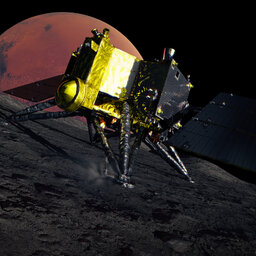
From the Mojave to Phobos: PlanetVac rides with MMX
1:04:21
Space Policy Edition: What does “science as a service” really mean?
1:17:02