 Under The Radar
Under the Radar: How is MongoDB positioning itself for the next phase of enterprise computing?
For decades, software applications were built around a relatively straightforward premise. Businesses stored information in structured tables, rows and columns neatly organised inside relational databases.
But the internet has changed everything, with modern applications now expected to process vast amounts of structured and unstructured data, scale across millions of users and integrate with hundreds of services.
Not to mention that they’re also increasingly being used to power artificial intelligence.
What this means is that traditional databases that bound information by parameters in rows and columns are now struggling to keep pace.
This change has given rise to a new generation of database platforms such as MongoDB that aims to help developers build modern applications faster.
Instead of storing data in rows and columns, MongoDB stores them like documents, making it easy to model data the same way the application code uses it. This allows developers to change their data model quickly and also handle non-uniform data.
Today, MongoDB serves over 67,000 customers across almost every industry, and counts about 75 per cent of Fortune 100 firms under its belt. Other notable clients include L’Oreal, Wells Fargo, Cathay Pacific Airways and Novo Nordisk.
The Nasdaq-listed company had also in May 2026 reported better-than-expected first quarter results for fiscal 2027 first quarter. MongoDB also raised its full-year fiscal 2027 guidance for revenue to a range of US$2.92 billion to US$2.96 billion.
But what are the key drivers for the firm at this point in time?
And turning our attention to the Asia Pacific region, how are organisations across the region modernising their application stack? Where is demand coming from and how is MongoDB positioning itself for the next phase of enterprise computing?
On Under the Radar, finance presenter Chua Tian Tian posed these questions to Thorsten Walther, Managing Director, CXO Advisory Asia at MongoDB.
In 3 playlist(s)



Under The Radar
We speak with businesses, industry leaders, venture capitalists and startups on their assessment of …Social links
Follow podcast
Recent clips
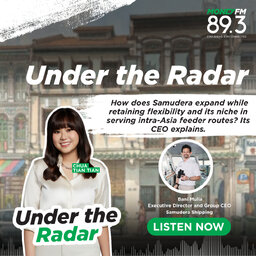
Under the Radar: How does Samudera Shipping expand while retaining flexibility and its niche in serving intra-Asia feeder routes? Its CEO explains.
28:19

Under the Radar: (SPECIALS) Why is Burger King, Popeyes and Tim Hortons’ parent Restaurant Brands International expanding aggressively in APAC right now?
24:39

Under the Radar: (SPECIALS) On the Go in Tokyo and Seoul — How is Levi’s capturing the hearts of its next generation consumers through its pop-ups featuring K-pop icon ROSE? It’s CMO and CCO explain.
31:16