 Mental Work

Understanding and identifying coercive control (with Krasi Kirova)
Bron is joined by Krasi Kirova (Clinical Psychologist) to chat about identifying coercive control in the therapy room. Krasi shares her own '3Ds' framework, built from years of clinical work, to help clinicians name abuse that doesn't always look obvious. They chat about: 👉🏽 Krasi's '3Ds' framew…
41:38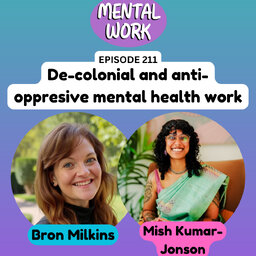
Decolonising your practice: Small steps toward anti-oppressive therapy (with Mish Kumar-Jonson)
Bron is joined by Mish Kumar-Jonson (Mental Health Social Worker and Chair of the Iceberg Foundation) about bringing anti-oppressive and anti-colonial practice into therapy. Mish shares how their own experience of migration and community shaped a lifelong commitment to supporting LGBTIQASBP+, neuro…
42:20
What does a school psychologist do? (with Renae Martelli)
Bron is joined by Renae Martelli (psychologist, Board-approved supervisor, and former school psychologist) to unpack what school psychology really involves. Renae shares how the role differs from private practice, why the work is more varied than most people expect, and how to figure out if being a…
37:58
What are "core needs" and why they matter in therapy (with Amy Howell)
Bron is joined by Amy Howell (Accredited Mental Health Social Worker, Co-Founder of Centre Self Collective) to unpack what our core psychological needs actually are and why they matter so much in clinical work. Amy shares how unmet needs in childhood shape attachment styles, coping patterns, and th…
33:56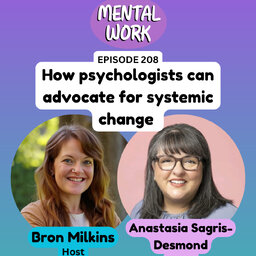
From client work to policy change: How psychologists can advocate for systemic change (with Anastasia Sagris-Desmond)
Bron is joined by Anastasia Sagris-Desmond (psychologist and graduate of the Pathways to Politics Program) about advocacy beyond the therapy room. Anastasia shares how three decades working in gambling harm and family violence led her into politics, union leadership, and co-authoring a book on coer…
34:40
How to stay evidence-based and keep up with research after you graduate: A guide for psychologists (Solo)
Bron tackles a listener question: how do you actually stay evidence-based once you're out of university, time-poor, and no longer have easy access to academic databases? She walks through the full range of free and low-cost options, from AI search tools to library memberships, so you can keep up-to…
15:21
Inside forensic psychology and working with violent and sexual offenders (with Kyle Miller)
Bron is joined by Kyle Miller (psychologist working in forensic private practice) about what it's really like to work with people who have committed sexual or violent offences. Kyle shares how he found his way into forensic work almost by accident, and why "I work with people" has become his guidin…
48:40
Authenticity without oversharing: What the research says about therapist self-disclosure (with Harriet Iles)
Bron is joined by returning guest Harriet Isles (psychologist and founder of Restorative Space Psychology) to talk about therapist self-disclosure. Harriet shares her practical, intentional approach to deciding when sharing personal information with a client helps the therapeutic relationship, and …
36:39
The post-registration clinical Masters bridging course and pivoting to non-client work (with Nishie Govender)
Bron is joined by Nishie Govender (clinical psychologist and occupational psychology consultant) for an honest conversation about building a career that looks nothing like the one you imagined. Nishie shares how realising full-time clinical work wasn't sustainable for her led to a fulfilling dual c…
38:17
Imagery rescripting deep dive (with Samantha Duroska)
Bron is joined by Samantha Duroska (clinical psychologist) for a practical deep dive into using imagery techniques in therapy. They chat about: 👉🏽 How to adapt if clients struggle to visualise 👉🏻 The common mistake of talking about imagery but not actually doing imagery 👉🏿 How to manage dis…
43:27