 Decoding Women's Health with Dr. Elizabeth Poynor
What can we do today to protect our bones, our muscles, and our joints for the future? Joining the show today is Dr. Jocelyn Wittstein - a clinician and researcher at Duke University, whose work sits at the intersection of women's health and musculoskeletal health.
We break down the latest research, while outlining the effects of estrogen loss on muscle mass and function. But most importantly, we discuss what we can actually do about it. Dr. Wittstein has tips on which habits to adopt to maintain and strengthen your body.
Links to resources mentioned in this episode:
Tips to improve bone density: https://content.atria.org/article/how-to-support-your-bone-density/
What to know about grip strengtheners: https://content.atria.org/article/what-to-know-about-grip-strengtheners/
Anti-inflammatory diet tips: https://content.atria.org/article/your-guide-to-the-mediterranean-diet/
All about vitamin D: https://content.atria.org/article/your-guide-to-vitamin-d/
NOTE: DEXA scans are simple 15-minute tests that can be done at some gyms, standalone businesses, or through your doctor. You do not need a prescription for one, but since your insurance may cover it, it's worth asking your doctor to order it for you.
Postmenopausal hormone replacement therapy modifies skeletal muscle composition and function: a study with monozygotic twin pairs: https://pubmed.ncbi.nlm.nih.gov/19246654/
Association Between Hormone Therapy and Muscle Mass in Postmenopausal Women: A Systematic Review and Meta-analysis: https://pubmed.ncbi.nlm.nih.gov/31461147/
Estrogen deficiency accelerates lumbar facet joints arthritis: https://www.nature.com/articles/s41598-017-01427-7
Are there gender-specific differences in hip and knee cartilage composition and degeneration? A systematic literature review: https://pmc.ncbi.nlm.nih.gov/articles/PMC11101511/
Hormone replacement therapy (conjugated oestrogens plus bazedoxifene) for post-menopausal women with symptomatic hand osteoarthritis: primary report from the HOPE-e randomised, placebo-controlled, feasibility study: https://www.thelancet.com/journals/lanrhe/article/PIIS2665-9913(22)00218-1/fulltext
Beyond reproduction: the role of progesterone in neuropathic pain after spinal cord injury: https://pmc.ncbi.nlm.nih.gov/articles/PMC5020818/
Progesterone and Bone: Actions Promoting Bone Health in Women: https://pmc.ncbi.nlm.nih.gov/articles/PMC5020818/
Are there sex differences in the association between the incidence of knee osteoarthritis and its known risk factors? the Rotterdam study: https://pmc.ncbi.nlm.nih.gov/articles/PMC5020818/
Associations between testosterone and knee and hand osteoarthritis among males and females from the general population: https://www.sciencedirect.com/science/article/abs/pii/S1063458425008787
Is There a Relationship Between Kinesiophobia and Physical Activity Level in Patients with Knee Osteoarthritis? https://pubmed.ncbi.nlm.nih.gov/33372230/
Is Hormone Replacement Therapy Associated with Reduced Risk of Adhesive Capsulitis in Menopausal Women? A Single Center Analysis: https://scholars.duke.edu/publication/1616498
High-Intensity Resistance and Impact Training Improves Bone Mineral Density and Physical Function in Postmenopausal Women With Osteopenia and Osteoporosis: The LIFTMOR Randomized Controlled Trial: https://pubmed.ncbi.nlm.nih.gov/28975661/
A comparison of different exercise intensities for improving bone mineral density in postmenopausal women with osteoporosis: A systematic review and meta-analysis: https://pmc.ncbi.nlm.nih.gov/articles/PMC9615132/
Effectiveness of whole-body vibration on bone mineral density in postmenopausal women: a systematic review and meta-analysis of randomized controlled trials: https://pubmed.ncbi.nlm.nih.gov/36282343/
How (and Why) to Add More Fiber to Your Diet: https://content.atria.org/article/how-and-why-to-add-more-fiber-to-your-diet/
Your Guide to Omega-3s: https://content.atria.org/article/your-guide-to-omega-3s/
Why VO2 Max Matters: https://content.atria.org/article/why-vo2-max-matters/
Note: In this show, we use “women” as shorthand for people with XX chromosomes. We understand sex and gender are more complex, and acknowledge the experiences we describe reach beyond that word.
In 1 playlist(s)
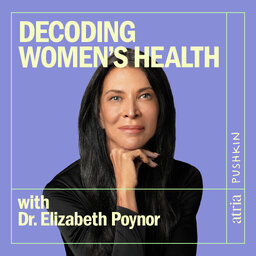
Decoding Women's Health with Dr. Elizabeth Poynor
Why is it still so hard for women to find reliable, modern health information about their own bodies…Social links
Follow podcast
Recent clips
Decoding Cardiovascular Health with Dr. Anu Lala
56:45
Decoding Intermittent Fasting with Dr. Chris Rhodes
49:07
Decoding Preventive Care with Dr. Jennifer McGugins Hill
59:15