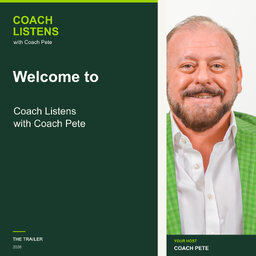
Coach Listens with Coach Pete
Start Here: Coach Listens
New to Coach Listens? Begin with this selection of conversations spanning retirement, entrepreneurship, technology, sports, entertainment, and persona…Bob Burg joins Steve Sedahl for the Financial Safari News Network to discuss The Go-Giver Influencer. They explore emotional control, listening, understanding another person's perspective, and influencing others without manipulation. Recorded May 2018.
Call 800-661-7383 or text PLAN to 600-700.
Transcript
Automatically transcribed from this episode; timestamps are approximate.
00:00 For the Financial Safari News Network, I'm Steve Sedahl. Today, we'll meet Bob Berg, co-author of the new book, The Go-Giver Influencer, a little story about a most persuasive idea. It's the third in a series of business parables, and some say it's the most important yet. A little about Bob Berg first. He's a former television personality turned top sales producer. He now speaks to corporations and other organizations on the principles embodied in the Go-Giver series. Bob, welcome. So how did the Go-Giver series come to be, and what is it about the Go-Giver Influencer that makes it so important? These days, you know, we are seeing, especially on the Internet, but there's also, whether it's a family get-together, a social event, whatever, we see that between family members and friends, employers, employees, politicians, political opponents,
00:46 and, you know, the millions of people on social media, today's discussions are really no longer discussions. They're really fueled up, hate-filled, vitriol-spilling diatribes and personal insults. Well, the result is that no minds are being chained, no one's being influenced, but rather people remain stuck in the echo chambers, if you will, of their already closely held beliefs. So friends are becoming enemies, discourse is shut down, understanding and acceptance not being reached, and people feel lousy about it, and that's really what we want to be able to now approach and kind of turn this around. It's being able to get the results you want when dealing with others, and this is, again, whether it's family members, friends, those you lead, those you work with, people in your social circles, what have you,
01:33 getting the results you want with everyone coming away a winner and feeling like a winner. So getting the results you want while making other people feel genuinely good about themselves, and the person who can do that, that's the person who's influential, and we have a lot of people saying that they're right away, they're giving this book to their kids and their grandkids, and, you know, because these are life skills. You know, talent is important. Talent is very important, but talent is the bottom, you know, talent is the baseline now for just getting into the game. It's those people who've mastered people's skills, but doing so in a way that's genuine and authentic and benevolent, not manipulative, but persuasive. That's the person who really is nine steps ahead of the game in a 10-step game. Well, and you've got the five secrets of the genuine influencer, and boy, they really ring true,
02:24 and I'm going to skip right to number five, let go of having to be right. And that is the thing that it just, you know, that's the frustrating part of it, is because if you have to be right, that means somebody has to be wrong, and guess what? They're not necessarily wrong. Well, exactly. And, you know, if you ever notice the political debates on social media, or, again, even in person, and someone says, people like you are the worst people on earth, you're heartless, and you don't care, and blah, blah, blah, you want to ruin this country. You know, the other person never responds by saying, oh, thank you so much for pointing out the error of my ways. I haven't thought about it like that, right? And so, no, what we've got to do is we've got to first, you know, we need to see this person as a person who has good intent, because they probably do.
03:10 The big difference is the way you would go about having something happen. And when we say let go of having to be right, that doesn't mean you don't desire to be right. It doesn't mean you don't do your best to be right. What it means is you allow yourself to go into learner's mode, as opposed to the people who, when you debate with them, you think to yourself, goodness, you know, it's like, don't even bother confusing them with the facts. Their mind is already made up. These are the people who have trouble with confirmation bias, right? They hear something that agrees with their already held beliefs. They believe it. If not, they ignore it. Well, that person cannot grow. But if you will let go of having to be right, you'll find that you're able to look at something from the other person's point of view. That does not mean you agree with it.
03:56 It just means you're able to see where they're coming from. And it puts you actually in a much stronger influential position. Hey, remember, tact should never be confused with compromise. You can always speak to someone with tact and with respect without compromising your values. And the neat thing about that is to the degree you do that, not only are you more influential with that person, but all the other people who are sort of watching, right? Right. They tend to take more to you as well. Bob, let's get to this list and talk about the five secrets of the genuine influencer or influence. One is master your emotions. Absolutely. Yeah, well, this is so tough because we're human beings, right? Yeah. And we're emotional creatures.
04:42 We'd like to think we're logical, but we're pretty emotionally driven. We make major decisions based on very limited or based on emotion. Then we back up those emotional decisions with logic. We rationalize, which simply means we tell ourselves rational lies in order to justify it. So what we need to do is, you know, it's not a matter of foregoing your emotions or denying them. There's no reason for that. Emotions are a great part of life. Just make sure you're the master of your emotions as opposed to they being the master of you or, as we like to say, by all means, take your emotions along for the ride, but make sure you are driving the car. See the types of situations that occur in your life, whether it's with people or circumstances that tend to just really get your emotional hot button. Right. And you it causes yourself to to become frustrated or impatient or angry.
05:33 Right. And you know how that feels when it happens. Well, now what I want you to do is I want you to picture the same situation. But now I want you to picture not being surprised by it. That's what usually happens. It takes us by surprise. But I want you to rehearse this a number of times. Rehearse this person or the situation or something similar. Um, and, and just kind of picture yourself handling it beautifully that it just, it doesn't bother you. You're able to listen to that person without interrupting. You're able to say the perfect thing. Again, don't worry about the words that comes later. Just get the feeling of this. And what I want you to do is practice it just like an astronaut before they go up into space, they would run hundreds of simulations. Right. So that by the time they get up there, if something actually happens, heaven forbid, well, they're
06:21 already been there. They've done that. They can, they can handle it because they've seen it tons of times. It's the same with this practice it in your mind again and again and again, and keep getting that good feeling of how you're handling it beautifully. Now, when it comes up, I want you to just do that very thing. And when you do feel good about it and understand two things. One is if you can do it right. One time you could do it right. Every time. Now, the second thing is you won't do it right. Every time because you're a human being and we all mess up from time to time. But I'll tell you this because I had to do this 25, 30 years ago when I was having a real issue with, with anger. And I've taught lots of people how to do this. And all of our lives have been changed dramatically because when you're not at the mercy of your
07:08 emotions, when you are the boss of yourself, first of all, you feel better about yourself. You're much more effective and you're much more influential. So step number two is step into the other person's shoes. You know, you try to do that or I try to do that. And again, that's not always easy either. And that's because most of us have different size feet. In other words, we come from different ways of seeing the world, different experiences, different belief systems. So we can't necessarily step into their shoes. So what we need to do to make up for that is we ask questions. We discover, hey, we do this in sales. What is selling? It's simply discovering what the other person wants, needs or desires and helping them to
07:55 get it. It's the same with influence. So ask questions, but don't just listen with your ears. OK, as one of the mentors in the story, because it's a parable, one of the mentors in the story tells his protege, don't just listen with your ears. That's the surface listening. Most of us do. That's listening in order to speak, in order to have a comeback. Right. No. Listen with your eyes. Listen with your posture. Listen, he said, with the back of your neck. In other words, put your entire being into listening. What happens is not only do you actually discover more about what drives that other person, which is so important, but they feel listened to and they become much more responsive to your idea. People want to feel understood. The only way you can understand another person, step into their shoes, is by asking questions
08:44 and listening. I think it's really just a matter of understanding that when you can move from an I focus or me focus to what we call an other focus, this is the way that you make yourself the most influential. Because remember, and Dale Carnegie said this in his classic How to Win Friends and Influence People. Ultimately, people do things for their reasons, not our reasons. So as mature human beings, we need to understand and tap into human nature in a very positive, benevolent way and understand that if we want to influence someone to do a certain thing, we need to give them a reason that works for them. The book is called The Go-Giver Influencer, a little story about a most persuasive idea, written by Bob Berg and John David Mann.
09:31 Thanks again to author Bob Berg for chatting with us today. To learn more and get two free chapters of the book, just visit thegogiver.com. That's thegogiver.com. I'm Steve Sedahl for the Financial Safari News Network.